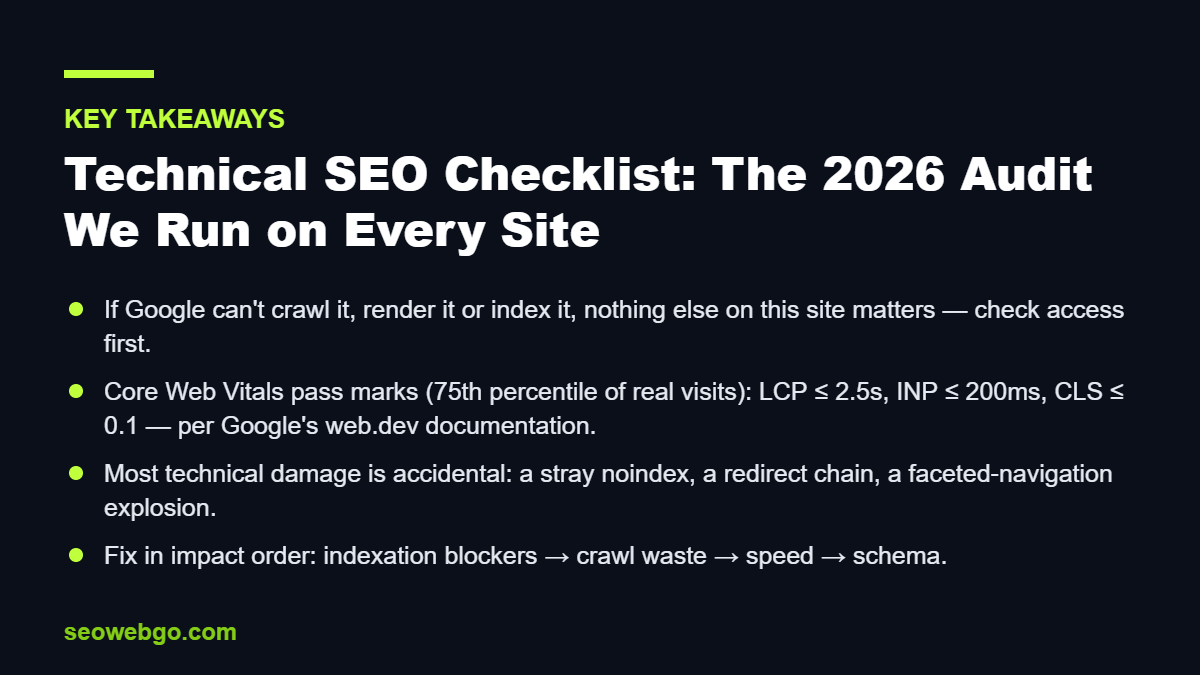
TL;DR — technical SEO in five lines
Technical SEO is unglamorous and decisive. Content earns rankings only on pages search engines can reach, understand and serve quickly — and the failures are usually silent: nobody notices a template shipping noindex until the traffic graph explains it. This is the checklist order our Technical SEO service follows, from “can Google see it at all” down to polish.
- If Google can’t crawl it, render it or index it, nothing else on this site matters — check access first.
- Core Web Vitals pass marks (75th percentile of real visits): LCP ≤ 2.5s, INP ≤ 200ms, CLS ≤ 0.1 — per Google’s web.dev documentation.
- Most technical damage is accidental: a stray noindex, a redirect chain, a faceted-navigation explosion.
- Fix in impact order: indexation blockers → crawl waste → speed → schema.
- Monitor monthly. Technical SEO decays on its own as sites change.
FIND YOUR PATH
What’s your biggest technical worry?
START HERE
Crawl + index checkWHY
If Google can’t index it, nothing else mattersWHERE TO CLICK
Search Console › Pages1. Crawlability
- robots.txt reviewed line by line: no accidental Disallow on key sections, CSS or JS; AI crawlers (OAI-SearchBot and friends) decided deliberately, not blocked by default.
- XML sitemap exists, is submitted in Search Console, and lists only live, indexable, canonical URLs.
- Server responds fast and clean: no widespread 5xx, no soft-404s, redirect chains kept to one hop.
- Crawl budget sanity (larger sites): faceted navigation, filters and calendar traps fenced off so Googlebot spends its visits on money pages.
2. Indexation

- Search Console → Pages report reviewed: every “Excluded” reason understood, every important page indexed.
- Canonical tags self-referencing on unique pages; duplicates (print, parameter, http/https, www/non-www) consolidated.
- noindex appears only where intended — staging settings and theme defaults are the classic culprits.
- Orphan pages (no internal links) found via crawl and either linked or removed.
3. Site architecture
- Every important page reachable within 3 clicks of the homepage.
- One clear hierarchy (like this site’s Services → SEO → specialisms) reflected in URLs and breadcrumbs.
- Internal links use descriptive anchors; no vital page depends on JavaScript-only navigation.
4. Speed — Core Web Vitals
- Judge by field data (CrUX / Search Console), not lab scores alone. Thresholds at the 75th percentile: LCP ≤ 2.5s, INP ≤ 200ms, CLS ≤ 0.1.
- LCP: hero image optimized and preloaded, no render-blocking bloat.
- INP: long tasks broken up; heavy widgets deferred until interaction (see our WordPress INP guide).
- Test any URL right now with our free PageSpeed & Core Web Vitals Checker — it runs Google’s own test and exports a PDF report.
5. Mobile, security and structured data
- Mobile rendering checked on a real mid-range phone: tap targets, readable type, no horizontal scroll.
- HTTPS everywhere, mixed content eliminated, one canonical host version.
- Structured data matches the visible page (Organization, Service, FAQ, Article, Product) and validates — generate it free with our Schema Generator.
6. Monitoring (the step everyone skips)
- Monthly: Search Console coverage + vitals reviewed; crawl stats checked after every release or redesign.
- Rankings watched daily during any migration or fix window, so a regression is caught in days, not quarters.